
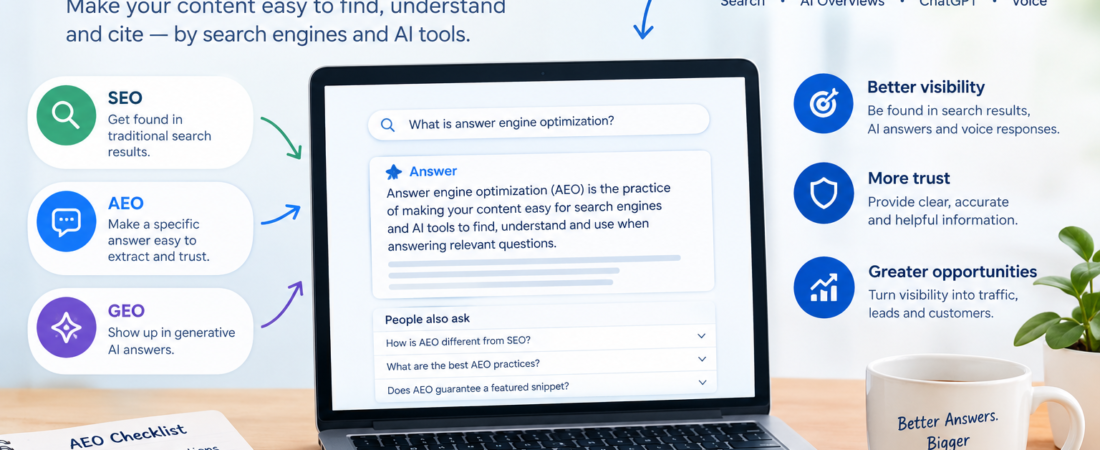
Answer engine optimization helps make your website content easier for search engines and AI-powered tools to find, understand, and use when answering questions. It focuses on clear answers, useful information, trustworthy sources, and accessible website content.
Search behavior is changing. People still use Google to find websites, but they also ask questions through AI-powered search experiences, including Google AI Overviews, ChatGPT search, and other conversational tools.
For businesses, this creates an important opportunity. Your website needs to do more than target keywords. It should provide accurate answers that meet search intent, demonstrate real expertise, and help readers make informed decisions.
The good news is that you do not need to abandon traditional SEO to improve your AEO performance. Many of the same practices support both.
In this guide, you will learn 10 practical answer engine optimization best practices, how AEO differs from SEO and GEO, and how to improve your website’s visibility without relying on shortcuts or unrealistic promises.
What Is Answer Engine Optimization?
Answer engine optimization is the practice of structuring and improving website content so that search engines and AI-powered answer systems can identify, understand, and potentially reference relevant information.
It includes answering questions directly, organizing content with descriptive headings, publishing reliable information, improving crawlability, and supporting important claims with credible sources.
For example, an article targeting the question “What is WordPress SEO?” should define WordPress SEO near the beginning, explain its main components, and provide practical steps readers can follow.
AEO does not guarantee that Google or an AI tool will select your content. Its purpose is to make your pages more useful, accessible, and suitable for relevant search experiences.
How Is AEO Different from SEO and GEO?
SEO, AEO, and GEO overlap, but each emphasizes a different aspect of online visibility.
| Approach | Main goal | How to measure success |
|---|---|---|
| SEO | Improve visibility in organic search results | Rankings, impressions, clicks, and qualified organic traffic |
| AEO | Make answers easy to identify and extract | Featured snippets, answer-focused results, and relevant citations where measurable |
| GEO | Improve visibility in generative AI responses | Brand mentions, linked citations, and referrals from AI platforms |
SEO provides the foundation by helping search engines discover, crawl, and understand your website. AEO emphasizes how clearly you answer specific questions. GEO focuses on how your information or brand appears in AI-generated responses.
These approaches should work together rather than operate as three separate content strategies.
A useful starting point is to publish helpful, well-structured pages, strengthen internal links, demonstrate expertise, and ensure that search systems can access your content.
Where Can Answer Engines Use Your Content?
Different search experiences select and present information in different ways. Understanding these differences helps you choose the right content format.
| Search surface | What may help your content qualify | What you can improve |
|---|---|---|
| Featured snippets | A clear definition, list, table, or sequence | Direct answers and relevant headings |
| People Also Ask | Useful answers to related questions | Question-based headings and concise explanations |
| Google AI Overviews and AI Mode | Helpful, accessible pages that are eligible for search | Indexing, content quality, and internal links |
| ChatGPT search | Relevant pages accessible to its search systems | Crawler access, useful content, and clear page structure |
| Voice search | Concise answers written in natural language | Plain wording and direct opening sentences |
There is no setting that guarantees your website will appear in these features. Search platforms decide which sources best serve a particular query.
Your goal is to make the page accurate, relevant, easy to understand, and technically accessible.
10 Answer Engine Optimization Best Practices for 2026
1. Research the Questions Your Audience Actually Asks
Effective answer engine optimization begins with understanding what your audience wants to know.
Instead of choosing topics only because they contain popular keywords, identify the questions people ask before purchasing a product, hiring a service provider, or solving a problem.
Useful research sources include:
- Google Search Console queries and impressions
- Google’s People Also Ask results and related searches
- Customer emails, sales conversations, and support questions
- Competitor articles addressing the same search intent
- Keyword research tools such as Ahrefs, Semrush, and AnswerThePublic
Organize questions by intent so that each page serves a clear purpose.
For example:
- Definition: What is answer engine optimization?
- Comparison: What is the difference between AEO and SEO?
- Process: How do I optimize a WordPress website for search?
- Decision: Does AEO require structured data?
- Commercial: How much does an SEO specialist cost?
Build one comprehensive page around a primary topic and include closely related questions where they genuinely help readers. Avoid publishing multiple thin articles that answer almost the same question.
2. Answer the Main Question First
One of the most practical AEO best practices is to provide a direct answer near the beginning of each section.
Readers should not need to scroll through a long introduction to understand the point of a heading. Clear opening sentences also make individual sections easier to interpret when they are encountered outside the full article.
Weak example:
“In today’s rapidly evolving digital landscape, businesses must adapt to changing technologies and discover new opportunities to improve their online presence.”
Better example:
“Answer engine optimization helps make website content easier for search engines and AI tools to understand and reference when answering relevant questions.”
The second example addresses the topic immediately.
Use this structure when writing important sections:
- Answer the question in the opening sentences.
- Explain the process, criteria, or limitations.
- Include a practical example or original observation.
- Link to a related resource if the reader needs additional information.
A short answer can be helpful, but there is no universal word count that guarantees selection in an AI response. Focus on completeness and clarity rather than writing to an arbitrary length.
3. Structure Your Content for Easy Understanding
A well-organized page helps readers navigate the information and helps search systems interpret relationships between topics.
Use a logical heading hierarchy:
- One clear H1 for the main article title
- H2 headings for major sections
- H3 headings for supporting topics within those sections
Choose the content format that matches the question.
Use definitions for “what is” queries, numbered steps for “how to” queries, and comparison tables when readers need to evaluate different options.
Keep paragraphs focused, use descriptive link text, and avoid burying essential information beneath oversized banners or lengthy introductions.
For WordPress websites, these improvements can often be made directly in the block editor or page builder.
For a more detailed technical and on-page workflow, read the WordPress SEO guide.
4. Publish Original, Helpful Information
Clear headings alone will not make an article worth citing. Your content should provide value beyond what readers can find in dozens of similar articles.
Google’s guidance emphasizes helpful, reliable, people-first content. Original information and practical experience can make your pages more useful and distinctive.
Consider adding:
- A real example from your website or professional work
- A checklist that readers can apply immediately
- Screenshots that demonstrate a process
- A comparison based on clearly stated criteria
- An explanation of when a tactic works and when it may not
- Findings from your own research or documented results
For example, instead of writing “Improve your internal linking,” explain how to identify relevant pages, choose descriptive anchor text, and link from existing articles to the most useful related resource.
Never invent client results, traffic improvements, or case studies to make a page appear authoritative. If you use an example, label it accurately as a real result, an illustrative example, or a hypothetical scenario.
AEO cannot guarantee citations, featured snippets, rankings, or leads. Your content should make realistic claims and provide evidence wherever possible.
5. Demonstrate Experience and Trust
People need to know who created your content and why they should trust it.
Search engines also use a range of signals to assess the quality and relevance of information. A plugin score or author biography alone cannot establish trustworthiness.
For important articles, consider including:
- A real author name and relevant biography
- An accurate publication date and meaningful update date
- Links to primary sources for technical claims
- Consistent business details and contact information
- Examples that demonstrate genuine knowledge
- Clear distinctions between established facts and personal opinions
For Maria Khan Digital, connect educational articles to relevant service pages, explain your actual SEO process, and show examples of work you can substantiate.
If your website serves local customers, maintain accurate information on your Google Business Profile. If you sell eligible products, keep relevant Merchant Center information accurate as well.
Trust is built through consistent, transparent information rather than claims that cannot be verified.
6. Fix Technical SEO Before Chasing AI Visibility
Technical problems can prevent otherwise useful content from reaching its intended audience.
Before spending time on advanced AEO tactics, make sure your important pages are accessible, indexable, and linked appropriately.
Check the following:
- The page returns a successful HTTP status, normally 200.
- Search engines are allowed to crawl the relevant content.
- The page is not unintentionally marked
noindex. - The canonical URL points to the preferred version of the page.
- Important text is available as readable page content rather than only inside images.
- The page is linked from relevant pages on your website.
- The XML sitemap includes the appropriate canonical URLs.
- The page works well on mobile devices.
- Search Console does not report unresolved indexing problems.
Also review preview controls such as nosnippet, data-nosnippet, and restrictive max-snippet settings. These can limit how content appears in certain search features.
For Google AI features, Google explains that existing Search eligibility requirements apply and that there are no special additional technical requirements for inclusion in AI Overviews or AI Mode. Eligibility does not guarantee selection.
You can review the official Google Search Central guidance on AI features.
Allow the appropriate crawlers
ChatGPT search and Google’s search experiences do not use exactly the same systems.
OpenAI identifies OAI-SearchBot as the crawler used to help surface websites in ChatGPT search. GPTBot is associated with collecting content that may be used for model training. These have different purposes.
If you want your site to be discoverable through ChatGPT search, review your hosting and firewall settings and allow OAI-SearchBot where appropriate.
A simplified robots.txt example is:
User-agent: OAI-SearchBot
Allow: /

User-agent: GPTBot
Disallow: /
The second rule blocks GPTBot; it is optional and should reflect your own training-data preferences. It is not required to enable ChatGPT search visibility.
Check your existing robots.txt before making changes, and review the current OpenAI crawler documentation for the latest details.
7. Use Structured Data Correctly
Structured data helps search engines understand the information on a page. It does not guarantee rankings, AI citations, or rich search results.
Choose schema that accurately represents your content.
| Schema type | Appropriate use |
|---|---|
| Article or BlogPosting | Educational articles and blog posts |
| Organization | Information about your business or organization |
| Person | Information about an identifiable author |
| BreadcrumbList | Breadcrumb navigation, when implemented appropriately |
| LocalBusiness | A genuine local business, when relevant |
| Product | A page describing a specific product |
FAQPage markup should only describe genuine, visible questions and answers where the markup is appropriate. Google has restricted FAQ rich results largely to well-known, authoritative government and health websites, so adding FAQ schema to a typical business blog does not guarantee an FAQ rich result.
Likewise, do not add HowTo markup solely to pursue a search feature that may not be available for your site.
If you use Rank Math on WordPress, review its schema settings and confirm that the generated markup accurately describes the visible content. Avoid duplicating conflicting schema from multiple plugins.
The basic rule is simple: structured data should describe the page, not make promises about what search engines will display.
8. Build Topic Clusters With Internal Links
Internal linking helps readers discover related resources and helps search engines find and understand the relationships between pages.
Rather than publishing disconnected articles, build a small group of useful resources around your main services.
For example, the Maria Khan Digital website can connect this article to:
- The WordPress SEO guide for technical and on-page optimization
- The free backlinks guide for link-building strategies
- The SEO specialist cost guide for service pricing information
- The SEO services page for commercial information
- The contact page for enquiries
Use descriptive anchor text that tells readers what they will find after clicking.
For example, “Read the WordPress SEO guide” is more informative than “Click here.”
Add links where they provide context. Avoid forcing every link into every article or repeating the same anchor unnaturally.
Review older blog posts, too. When a relevant article already exists, add a contextual link from that article to the new resource and link back where useful.
9. Earn Relevant Mentions and Backlinks
Your website is not the only place where your business can demonstrate credibility.
Relevant mentions, editorial links, professional contributions, and consistent business information can help people discover your brand and provide additional context about your expertise.
Practical activities include:
- Writing useful guest articles for relevant industry websites
- Contributing original insights to specialist publications
- Building relationships with businesses serving similar audiences
- Publishing resources that other websites genuinely want to reference
- Maintaining accurate professional profiles
- Earning mentions through partnerships, interviews, and case studies
Focus on relevance and editorial value rather than the number of backlinks alone.
Buying links intended to manipulate rankings or publishing large volumes of low-quality guest posts can create risks without producing meaningful business results.
If you are starting with a limited budget, use the practical methods in the free backlinks guide to develop a realistic outreach process.
Remember that backlinks are one part of a broader strategy. They cannot guarantee that an AI system will mention or cite your business.
10. Measure AEO Performance Over Time
Answer engine optimization should be evaluated through observable results rather than assumptions about how often AI systems might use your content.
Start with traditional SEO measurements, then add AI visibility checks where suitable data is available.
Track the following:
- Google Search Console impressions, clicks, and average position
- Search queries associated with your target pages
- Changes in relevant featured snippets and People Also Ask results
- Referrals from AI platforms, where analytics can identify them
- Brand mentions and linked citations across a fixed set of relevant questions
- Leads, enquiries, or assisted conversions from updated pages
For AI visibility checks, select 15 to 30 questions your prospective customers are likely to ask. Run the same questions periodically, record the date and platform, and note whether your website or competitors appear.
AI responses can vary between searches, so one screenshot is not reliable evidence of a sustained improvement.
Where possible, compare similar pages or update a small group of articles first. For example, improve the openings of five relevant posts and compare their performance with similar pages that have not yet been updated.
Review the results after enough time has passed to collect meaningful data. The appropriate period depends on crawl frequency, search demand, and the number of impressions available.
A Practical Answer Engine Optimization Checklist
Use this checklist before publishing or updating an important page.
- The article has one clear primary search intent.
- The SEO title and H1 accurately describe the topic.
- The primary keyword appears naturally in the introduction.
- The opening paragraph directly answers the main question.
- Headings follow a logical H1, H2, and H3 hierarchy.
- Relevant questions are answered clearly and accurately.
- Tables, lists, or steps are used where they improve understanding.
- The article includes original examples or useful practical details.
- Important claims link to credible primary sources.
- The author and business information are accurate.
- The canonical URL and indexing settings are correct.
- The page is included in relevant internal links.
- Any structured data matches the visible content.
- The meta description is clear and relevant.
- The page works well on mobile devices.
- Performance and visibility can be reviewed in analytics tools.
You do not need to complete every optional enhancement before publishing. Prioritize accuracy, reader value, indexing, and a clear page structure.
Common Answer Engine Optimization Mistakes to Avoid
Writing for algorithms instead of people
Short answers can improve clarity, but keyword stuffing, unnatural sentences, and disconnected FAQ sections make articles harder to read. Write for the person who needs the answer.
Expecting schema to guarantee citations
Structured data describes content. It does not force Google or an AI platform to feature your page.
Blocking crawlers without understanding the consequences
A robots.txt rule, noindex directive, or restrictive snippet setting can affect discoverability or how your content appears. Understand what each control does before changing it.
Publishing too many thin articles
Creating separate pages for minor keyword variations can result in repetitive content and unnecessary maintenance. Combine overlapping topics when one comprehensive page can serve the same search intent more effectively.
Adding technical features without a clear purpose
Do not assume that an optional file, special markup, or AI-specific plugin will automatically improve visibility. Start with the documented requirements and the quality of your content.
Ignoring conversion opportunities
An informational article can attract relevant visitors without generating enquiries. Connect it naturally to a relevant service, case study, or contact page so readers can take the next step when they are ready.
How Can a Small Business Start AEO This Month?
You do not need a large marketing team or an expensive collection of tools to begin improving your answer engine optimization.
Start with five important pages: your homepage, one service page, and three useful articles.
Week 1: Identify opportunities. Review Search Console and customer questions. Choose the main question each page should answer.
Week 2: Improve content. Rewrite introductions, clarify headings, add useful examples, and remove repetitive information.
Week 3: Fix website issues. Check indexing, canonicals, internal links, mobile usability, and relevant crawler settings.
Week 4: Measure and review. Record baseline performance, check important queries, and begin tracking relevant AI mentions and referrals.
Continue improving pages based on evidence. This focused approach is generally more useful than publishing a large batch of generic articles without reviewing their quality or performance.
Frequently Asked Questions About Answer Engine Optimization
What is answer engine optimization in simple terms?
Answer engine optimization is the process of making website content easier for search engines and AI tools to understand and potentially use when answering questions. It involves clear answers, useful structure, reliable information, and technical accessibility.
Is AEO the same as SEO?
No. SEO is the broader practice of improving visibility in organic search. AEO emphasizes clear, extractable answers across search and answer experiences. Both benefit from relevant content, technical accessibility, and a useful website structure.
What is the difference between AEO and GEO?
AEO focuses on making answers easy to identify and use, while GEO focuses on visibility in generative AI responses. Their practical methods overlap, including helpful content, clear structure, credible sources, and accessible pages.
How do I get my website into Google AI Overviews?
There is no guaranteed placement. Make sure your pages can be crawled and indexed, provide helpful and accurate information, use clear headings, and build relevant internal links. Follow Google’s current Search guidance and monitor results over time.
Does FAQ schema guarantee an AI citation?
No. FAQ schema does not guarantee AI citations, rankings, or rich results. Use structured data only when it accurately describes content visible to readers.
Should I block AI crawlers?
That depends on your goals and policies. If you want your site to be eligible for ChatGPT search, review access for OAI-SearchBot. GPTBot serves a different purpose related to potential model training, so make that decision separately.
How long does answer engine optimization take?
Technical changes may be processed within days or weeks, but timing varies. Content improvements can take longer to show measurable results. Review indexing issues early and assess performance after collecting enough relevant data.
Can a small business do AEO without a large budget?
Yes. Start by improving a few important pages, answering genuine customer questions, strengthening internal links, and fixing technical issues. Consistent improvements to useful content can be a practical starting point without a large publishing budget.
Is AEO more important than traditional SEO in 2026?
Neither should automatically replace the other. Traditional search remains important for discovery, while answer-focused and generative experiences provide additional ways people may encounter information. A combined strategy helps businesses serve different search behaviors.
Conclusion
Answer engine optimization is not a shortcut to guaranteed AI visibility. It is a practical extension of creating useful content and making it easy to discover, understand, and evaluate.
Start by answering important customer questions directly. Support those answers with original information, clear headings, trustworthy sources, relevant internal links, and sound technical SEO.
Then measure what changes. Monitor organic search performance, relevant citations, referrals, and business enquiries rather than relying on isolated AI responses.
For small businesses, a few strong, well-maintained pages can provide a better foundation than a large collection of repetitive articles.
Need help improving your website’s search visibility?
Explore my SEO services for content optimization, technical SEO, and link-building support. You can also contact Maria Khan Digital to discuss a practical SEO strategy for your website.