
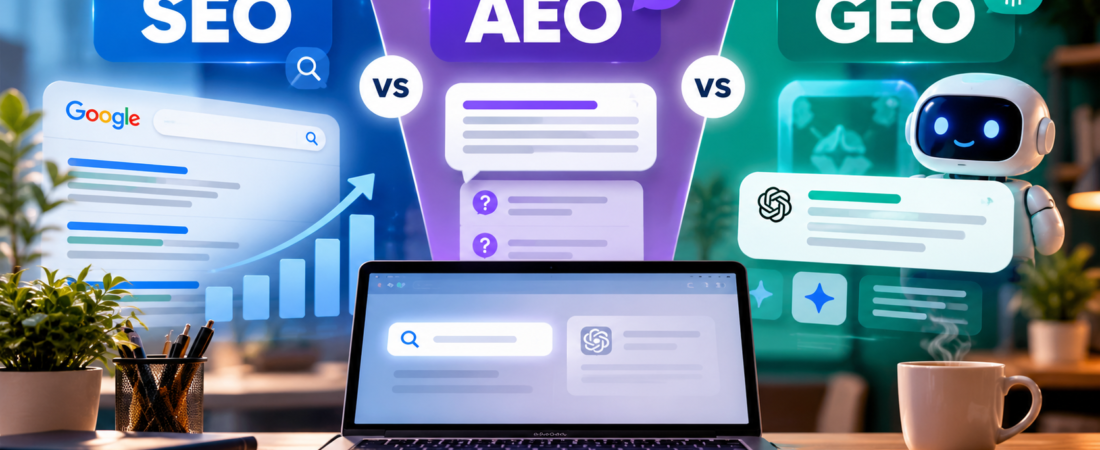
Search is changing rapidly. People no longer rely exclusively on traditional search engines to find information. They also ask conversational questions, explore AI-generated answers, and use AI-powered search experiences to research products, compare services, and solve problems.
These changes have introduced three important concepts in digital marketing: Search Engine Optimization (SEO), Answer Engine Optimization (AEO), and Generative Engine Optimization (GEO).
Understanding SEO vs AEO vs GEO helps businesses develop a more complete search visibility strategy. Rather than focusing exclusively on traditional rankings, marketers can work toward making their content useful, accessible, trustworthy, and discoverable across different search experiences.
In this guide, we will explain the differences between SEO, AEO, and GEO, explore practical optimization strategies, and share examples of how businesses can use all three approaches.
What Is SEO?
Search Engine Optimization (SEO) is the process of improving a website so that its pages can be discovered, understood, and ranked in organic search results.
Traditional SEO focuses on helping search engines understand website content and deliver relevant pages to people searching for particular information.
For example, a person searching for “best email hosting for small businesses” might see comparison articles, product pages, reviews, and service providers in the search results.
A business that wants to appear for this query needs relevant content, a technically accessible website, useful information, and credible signals that support its authority.
Key SEO Strategies
1. Keyword research
Identify the terms and questions your target audience searches for. Consider search intent, relevance, competition, and the purpose of each page.
2. On-page optimization
Optimize page titles, headings, URLs, introductions, image alt text, and content structure. Use keywords naturally instead of repeating them unnecessarily.
3. Technical SEO
Make sure search engines can crawl and index important pages. Address broken links, duplicate content, mobile usability, page performance, and other technical issues.
4. Quality content
Publish accurate, useful, original content that addresses readers’ needs. Demonstrate practical experience wherever possible.
5. Internal linking
Connect related pages so readers can explore additional information and search engines can discover the relationships between your content.
6. Relevant backlinks
Earn links from relevant, credible websites through valuable resources, original research, digital PR, and legitimate outreach.
Example of SEO in Action
Imagine you own a digital marketing website and want to rank for “SEO keyword research.”
You publish a detailed guide explaining keyword selection, search intent, keyword difficulty, and content planning.
You optimize the page title, use descriptive headings, link to related tutorials, and make sure the page is accessible to search engines.
These actions help search engines understand the page and determine whether it satisfies the searcher’s needs.
The goal of SEO: Improve relevant organic visibility and attract people who are searching for information, products, or services your website offers.
What Is AEO?
Answer Engine Optimization (AEO) is the practice of structuring and improving content so that answer-focused systems can identify and deliver useful responses to questions.
These systems may include featured snippets, voice assistants, conversational search experiences, and AI-powered answer interfaces.
AEO places particular emphasis on answering specific questions clearly and efficiently.
For example, someone might ask, “What is technical SEO, and why does it matter?”
Content that provides a direct definition followed by a useful explanation may be easier for an answer system to interpret than content that takes several paragraphs to address the question.
However, no particular format guarantees that a search engine or answer system will select your content.
Key AEO Strategies
1. Answer questions directly
Provide a concise, accurate response near the beginning of the relevant section. Follow it with supporting details and examples.
2. Use question-based headings
Organize content around genuine user questions, such as:
- What is Answer Engine Optimization?
- How does AEO work?
- What is the difference between AEO and SEO?
- How can businesses improve answer visibility?
3. Structure information clearly
Use descriptive headings, short paragraphs, numbered steps, and tables where appropriate. Make each section understandable without requiring readers to search through unrelated information.
4. Build topical coverage
Create useful pages that answer related questions about your subject. Link them together when the connections genuinely help readers.
5. Maintain accuracy
Support important claims with reliable evidence. Review content regularly when information changes.
6. Use structured data appropriately
Implement relevant, valid schema markup when it accurately describes the page. Structured data can help search engines interpret content, but it does not guarantee rich results or inclusion in AI answers.
Example of AEO in Action
Suppose your article targets the question “What is Answer Engine Optimization?”
You begin with a direct definition:
“Answer Engine Optimization (AEO) is the practice of improving content so that answer-focused systems can understand it and potentially use it to respond to users’ questions.”
You then explain how AEO works, provide examples, compare it with SEO, and answer related questions.
This structure makes the information easier for readers to navigate and can help answer systems interpret the content.
The goal of AEO: Make useful answers easier to identify, understand, and potentially surface in answer-focused search experiences.
What Is GEO?
Generative Engine Optimization (GEO) is the practice of improving a brand’s or website’s chances of being discovered, understood, and represented in responses generated by AI-powered search and conversational systems.
Examples of relevant experiences include ChatGPT search, Google AI Overviews, and other AI-powered research tools.
Unlike a traditional list of search results, generative systems can synthesize information from multiple sources into a single response. Depending on the product and query, they may also provide citations or links to sources.
GEO therefore considers how well your content communicates useful information, supports its claims, and contributes to the broader understanding of a topic.
Key GEO Strategies
1. Publish original and useful information
Develop content that offers more than a basic summary. Include practical examples, original observations, expert explanations, comparisons, or research where possible.
2. Support claims with credible sources
Use reliable references for factual claims, statistics, and technical explanations. Distinguish documented facts from opinions and estimates.
3. Demonstrate expertise
Explain how concepts work in practice. Include relevant experience, clear author information, and appropriate evidence of expertise.
4. Improve content clarity
Use specific language, meaningful headings, descriptive terminology, and logically connected explanations. Avoid vague claims and unnecessary repetition.
5. Strengthen your brand’s online presence
Maintain accurate business information and build genuine recognition through relevant publications, industry participation, useful resources, and reputable third-party mentions.
6. Measure AI visibility
Monitor whether your brand or content appears in relevant AI-generated responses. Where possible, record citations, linked pages, recurring prompts, and changes over time.
AI responses can vary, so individual observations should not be treated as definitive rankings.
Example of GEO in Action
Imagine a business publishes a detailed comparison of several website analytics approaches.
Instead of simply listing features, the article explains the differences, describes which use cases suit each approach, supports its claims with evidence, and provides transparent evaluation criteria.
A generative search system may find this information useful when answering a related question.
Whether the article is actually cited or referenced depends on the system, the query, the available sources, and many other factors.
The goal of GEO: Improve the likelihood that your expertise and content contribute to relevant AI-generated responses and brand discovery.
SEO vs AEO vs GEO: Key Differences
Although these approaches overlap, each emphasizes a different aspect of search visibility.
| Factor | SEO | AEO | GEO |
|---|---|---|---|
| Full form | Search Engine Optimization | Answer Engine Optimization | Generative Engine Optimization |
| Primary emphasis | Organic search visibility | Answer visibility | Visibility in generative AI responses |
| Typical experience | Search results pages | Direct answers and answer-focused interfaces | AI-generated summaries and responses |
| Content approach | Relevant, comprehensive, useful pages | Clear answers to specific questions | Useful, well-supported information that AI systems can interpret |
| Important considerations | Technical accessibility, intent, content, links | Direct answers, clear structure, accurate information | Content quality, evidence, clarity, source recognition |
| Measurement | Organic impressions, clicks, rankings, conversions | Answer visibility, featured results, relevant referrals | AI mentions, citations, linked sources, referral traffic |
| Main limitation | Rankings and clicks are not guaranteed | Selection for answers is not guaranteed | AI inclusion and citations are not guaranteed |
The important distinction: SEO focuses on organic search discoverability, AEO emphasizes answering questions effectively, and GEO focuses on visibility in generative AI experiences.
These are overlapping optimization approaches rather than completely separate disciplines. Strong foundational SEO can support AEO and GEO, although success in one does not guarantee success in the others.
How SEO, AEO, and GEO Work Together
Businesses do not necessarily need three separate content strategies. In many cases, they can improve visibility across all three through a coordinated approach.
To build a strong search visibility strategy, it is important to follow reliable industry guidance. Google’s SEO Starter Guide explains the fundamentals of search engine optimization, while its documentation on creating helpful, reliable, people-first content highlights the importance of producing useful content for readers. These principles can also support your approach to answer engine optimization (AEO) and generative engine optimization (GEO).
Consider a digital marketing agency that wants to attract businesses searching for SEO services.
Step 1: Build the SEO foundation
The agency publishes a useful service page and supporting articles targeting relevant search intent.
It ensures the website is crawlable, important pages are indexable, and content is easy to navigate.
Step 2: Improve answer visibility
The agency adds clear explanations of common questions, such as “What does an SEO audit include?”
It organizes the information into descriptive sections and provides practical examples.
Step 3: Strengthen generative search visibility
The agency publishes original case studies, explains its methodology, supports claims with evidence, and maintains consistent brand information.
It also monitors whether relevant AI-generated answers reference its website or brand.
Step 4: Measure performance
The agency tracks organic search performance, qualified website visits, leads, and available indicators of answer and AI visibility.
It uses those observations to improve content rather than assuming that a single optimization technique will work everywhere.
This combined approach creates a stronger foundation for discoverability across different search experiences.
Practical SEO, AEO, and GEO Optimization Checklist
Use this checklist when publishing or updating an article.
SEO Checklist
- Research the primary keyword and related search terms.
- Identify the searcher’s intent.
- Write a descriptive SEO title and meta description.
- Use a clear URL slug.
- Organize the content with logical headings.
- Add relevant internal and external links.
- Optimize images and their alt text.
- Check mobile usability and page performance.
- Confirm that the page can be indexed.
- Monitor impressions, clicks, and relevant conversions.
AEO Checklist
- Answer the main question near the beginning.
- Use descriptive, question-based headings where appropriate.
- Explain technical terms in plain language.
- Include relevant examples and concise definitions.
- Use lists and tables when they improve understanding.
- Address related questions without adding unnecessary filler.
- Keep important information accurate and up to date.
GEO Checklist
- Provide original insights and useful analysis.
- Support factual claims with trustworthy evidence.
- Make the author and publisher information clear.
- Maintain consistent brand and business information.
- Build genuine recognition through relevant industry sources.
- Make important information accessible to search systems.
- Monitor AI-generated mentions and citations where possible.
- Review whether AI-referred visitors engage with your content.
Remember that these are practical guidelines, not a formula that guarantees rankings, AI citations, or mentions.
Common Mistakes to Avoid
1. Treating AEO and GEO as replacements for SEO
Traditional search visibility still matters. Technical accessibility, useful content, and relevant organic discovery remain important parts of a sustainable strategy.
2. Writing content solely for AI systems
Content should help people first. Producing repetitive, generic articles simply to increase publication volume may fail to provide meaningful value.
3. Stuffing keywords into every paragraph
Use the primary keyword naturally. Related terminology should appear where it helps explain the subject, not merely to increase keyword frequency.
4. Assuming schema markup guarantees AI visibility
Structured data can clarify the meaning of a page, but adding schema does not guarantee that an AI system will select or cite the content.
5. Measuring success using only rankings
Rankings matter, but they are not the complete picture. Also monitor qualified traffic, engagement, conversions, brand mentions, and available AI citation data.
6. Publishing without a content plan
Articles should support your website’s main topics and link to relevant pages. A well-organized content library is more useful than a collection of disconnected posts.
How to Measure SEO, AEO, and GEO Performance
Each approach requires appropriate measurement.
For SEO:
- Organic impressions and clicks.
- Search queries and average positions.
- Organic landing-page traffic.
- Leads and conversions from organic visitors.
For AEO:
- Visibility in relevant answer-focused search features.
- Whether target questions surface your content.
- Referral traffic from answer-focused experiences, where available.
For GEO:
- Brand mentions in relevant AI responses.
- Citations and links to your website.
- Referral traffic from AI-powered platforms, where identifiable.
- Changes in visibility across a consistent set of relevant questions.
Google Search Console can help measure Google’s search performance. Analytics tools can help assess website traffic and conversions. Specialized AI visibility tools may provide additional monitoring, although their coverage and measurements vary.
Avoid comparing metrics from different tools as though they were directly equivalent.
Frequently Asked Questions
What is the main difference between SEO, AEO, and GEO?
SEO focuses on improving organic search visibility. AEO focuses on making information suitable for answer-focused systems. GEO focuses on improving visibility in generative AI responses.
Is GEO more important than SEO?
Not universally. The right priorities depend on your audience, industry, business goals, and where potential customers discover information. SEO remains a useful foundation for many websites, while AEO and GEO can extend a broader search visibility strategy.
Can one article be optimized for SEO, AEO, and GEO?
Yes. An article can target a relevant search query, answer common questions clearly, and provide well-supported information that generative systems can interpret. There is no guarantee that it will rank or be cited, however.
Do I need separate content for AEO and GEO?
Not necessarily. Many of the same improvements benefit both approaches. Separate pages make sense when search intent differs substantially or readers need distinct information.
How long does it take to see results?
The timeframe varies with website authority, competition, content quality, technical conditions, and the search platform. Organic rankings and AI visibility can change independently, so measure each over time.
Does GEO mean optimizing only for ChatGPT?
No. GEO can encompass multiple generative AI experiences. Different platforms use different systems and source-selection methods, so no single technique guarantees visibility everywhere.
Conclusion
SEO, AEO, and GEO represent related approaches to improving how people discover information and brands.
SEO provides a foundation for organic search visibility. AEO emphasizes clear, useful answers to specific questions. GEO focuses on making valuable information more discoverable and useful within generative AI experiences.
For businesses and digital marketers, the strongest approach is to combine technical accessibility, helpful content, credible evidence, clear information architecture, and appropriate performance measurement.
Start by understanding your audience’s questions, creating content that genuinely addresses them, and measuring how effectively that content attracts relevant visitors.
Related SEO Guides
Improving your search visibility requires a combination of effective strategies. Explore my guide to AI SEO in 2026 to understand how artificial intelligence is changing search optimization. You can also read my article on WordPress SEO best practices to learn how to improve your website’s technical performance, on-page SEO, and content structure. For a stronger foundation, my guide to keyword research explains how to identify relevant search terms and understand what your audience is looking for.
Search visibility is not just about appearing in results. It is about helping the right people find useful information wherever they search.