
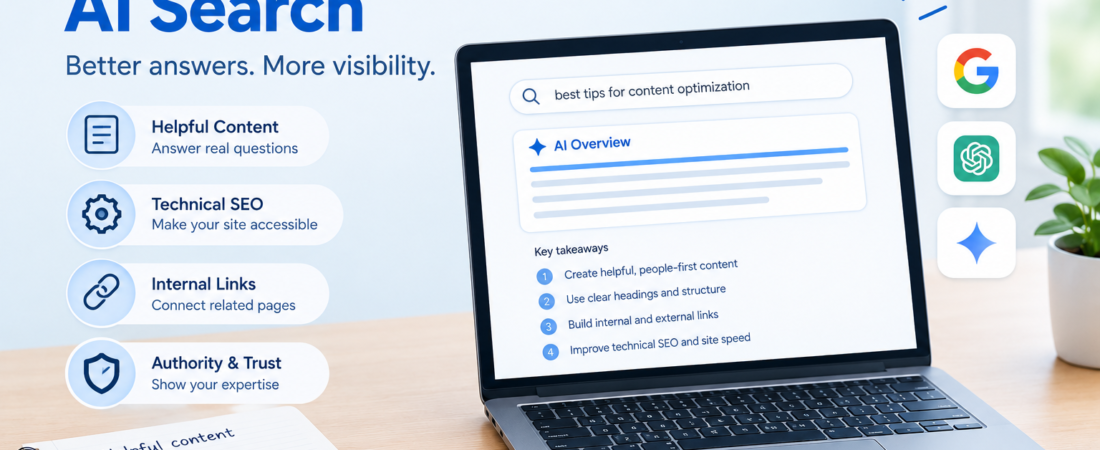
Search is changing. People still use traditional search engines, but they can also discover information through Google AI Overviews, AI-powered assistants, and conversational search tools. These experiences can summarize information, answer questions, and help users explore a topic without opening several websites.
For website owners, this creates a new challenge: how can you make content useful and accessible to both people and AI-powered search experiences?
The answer is not to abandon traditional SEO. To optimize content for AI search, start with strong SEO foundations, answer real questions clearly, demonstrate first-hand knowledge, and make your pages easy to crawl and understand. There is no guaranteed way to appear in AI-generated answers, but you can improve the quality and accessibility of your content.
This guide explains the practical steps businesses, bloggers, and SEO specialists can take in 2026.
What Does It Mean to Optimize Content for AI Search?
Optimizing content for AI search means creating and maintaining web pages that answer users’ questions accurately and can be discovered, crawled, and understood by relevant search systems.
Depending on the platform, AI search experiences may use web indexes, retrieval systems, language models, or a combination of these technologies. The exact process varies, so no single writing trick guarantees inclusion.
Effective AI search optimization combines several familiar SEO practices:
- Publishing helpful, accurate, people-first content.
- Answering specific questions with clear explanations.
- Organizing information with descriptive headings.
- Building topical depth and relevant internal links.
- Making important content accessible to search crawlers.
- Demonstrating expertise, credibility, and original value.
In short, the goal is to make your content worth finding, easy to understand, and useful to cite or reference.
10 Best Practices to Optimize Content for AI Search
1. Answer the main question early
One effective way to optimize content for AI search is to answer the main question in the opening paragraph of each important section. Follow the answer with supporting details, practical examples, and trustworthy references. This makes your article easier to navigate and more useful to readers.
Readers should not have to scroll through several paragraphs to discover the answer. Start with a direct explanation, then expand with examples, details, and supporting evidence.
For example, if your article targets “How do I optimize content for AI search?”, you could begin with:
To optimize content for AI search, publish accurate and helpful information, answer users’ questions clearly, strengthen your website’s technical SEO, and demonstrate first-hand expertise. These practices help search systems discover and understand your content, although inclusion in AI-generated answers is never guaranteed.
This format gives readers an immediate answer while providing a useful introduction to the rest of the article.
Practical tip: Add a concise answer below important question-based headings. Keep it natural rather than forcing every answer into an identical template.
2. Understand search intent before writing
AI search optimization begins with understanding what people want to accomplish.
Someone searching “AI search optimization” may want a definition, while someone searching “how to optimize a WordPress article for Google AI Overviews” needs a practical process.
Before writing, identify:
- The main question the page should answer.
- The reader’s knowledge level.
- Related questions that naturally belong in the article.
- The examples or evidence that would make the answer more useful.
- The next action the reader may want to take.
Use Google Search suggestions, Search Console queries, customer questions, and relevant discussions to discover real information needs.
Avoid creating dozens of near-identical pages for minor keyword variations. A comprehensive page that serves the reader well is often more useful than many repetitive articles.
3. Use clear headings and logical content structure
Organized content helps readers navigate an article and makes its relationships between topics easier to understand.
Use one clear H1 for the main page title, H2 headings for major sections, and H3 headings for supporting topics. Keep headings descriptive and relevant to the content beneath them.
For example:
- H1: Optimize Content for AI Search and Google AI Overviews
- H2: What Is AI Search Optimization?
- H2: How Google AI Overviews Work
- H2: Best Practices for AI Search Visibility
- H3: Improve Content Quality
- H3: Strengthen Internal Linking
- H2: How to Measure Results
Do not break every paragraph into a separate heading or make every section artificially short. Google does not require a special content structure for AI Overviews; clear organization is a practical way to improve usability.
Google for Developers
+1
4. Publish original information, not just generic advice
A page that repeats the same advice found on dozens of other websites has little reason to stand out.
Add value through:
- Original case studies and documented results.
- Screenshots that demonstrate a process.
- Examples from your own website or projects.
- Expert commentary supported by evidence.
- Comparisons that help readers make decisions.
- Lessons learned from testing a technique.
For example, instead of simply advising readers to improve internal linking, show how you connect a supporting blog post to a relevant service page and explain how that relationship helps visitors find the next useful resource.
Google’s guidance for generative AI search emphasizes unique, helpful content rather than material that simply repeats information already available elsewhere.
Google for Developers
5. Demonstrate expertise and trustworthiness
AI-generated summaries can bring readers to information about technical, financial, health, business, and other important topics. Accuracy and credibility matter.
To strengthen your content:
- Verify facts using reliable primary sources.
- Link to official documentation where appropriate.
- Explain who created the content and why they are qualified to discuss the subject.
- Update outdated statistics, screenshots, and recommendations.
- Distinguish established facts from personal opinions.
- Correct errors instead of allowing old information to remain published.
You do not need to invent credentials or claim results you cannot demonstrate. If you are still learning a subject, be transparent and focus on well-researched explanations and clearly documented experiments.
6. Strengthen traditional SEO and technical accessibility
Your content cannot perform well in search if important pages are inaccessible, blocked from crawling, or accidentally excluded from indexing.
Review these fundamentals:
- Confirm that important URLs return a successful response.
- Check indexing status in Google Search Console.
- Submit an accurate XML sitemap.
- Review robots.txt rules and page-level
noindexdirectives. - Use relevant internal links to help users and crawlers discover pages.
- Avoid duplicate URLs and unnecessary redirects.
- Make pages usable on mobile devices.
- Improve loading performance and fix important usability problems.
For websites that want to appear in ChatGPT search, review OpenAI’s crawler documentation and ensure that OAI-SearchBot is not unintentionally blocked. This is separate from Google’s crawling and indexing requirements.
Google for Developers
+1
7. Use structured data appropriately
Structured data helps search engines interpret certain types of information on a page and may make a page eligible for supported rich results.
Depending on your content, relevant schema types may include:
- Article for a blog post.
- Breadcrumb for page navigation.
- Organization for business information.
- Product for eligible product pages.
- LocalBusiness for appropriate local business pages.
Use Rank Math or another suitable tool to implement supported schema, then validate it and ensure that it accurately reflects visible page content.
Important: Schema is not a shortcut to AI Overview inclusion. Google states that there is no special schema markup required specifically for its generative AI search features. Use structured data for its legitimate SEO purposes, not as a guarantee of AI visibility.
Google for Developers
+1
8. Build relevant internal and external links
Internal links connect related pages on your website. External links help readers verify facts and explore authoritative resources.
For example, a website publishing an AI search guide might link to its related articles about:
Only use these links if the pages are published, accessible, and genuinely relevant to the surrounding text.
Use descriptive anchor text so readers understand what they will find after clicking. External links should support your claims, not simply exist to increase the number of links in the article.
Avoid buying links or publishing unrelated guest posts solely to manipulate rankings. Relevant, useful links are more valuable than a high count of low-quality links.
9. Optimize images and other useful media
Images, diagrams, screenshots, and videos can explain concepts that would otherwise require long descriptions. They can also give readers another way to understand your topic.
For each image:
- Choose a descriptive file name.
- Write concise, accurate alt text.
- Compress the file without noticeably damaging quality.
- Use an appropriate image format and dimensions.
- Place the image near the relevant explanation.
- Make sure any text inside the image is readable.
For this article, an appropriate image alt text would be:
“Content optimization for AI search and Google AI Overviews.”
Do not stuff the primary keyword into every image description. Alt text should describe the actual image, especially for visitors using screen readers.
10. Measure performance and keep improving
Do not judge your AI search strategy by a single ranking, screenshot, or third-party visibility score.
Track a combination of metrics:
| Metric | What it helps you understand |
|---|---|
| Search impressions | Whether your pages are appearing in Google Search |
| Organic clicks | How much search traffic reaches your website |
| Relevant query positions | How your pages perform for target topics |
| Conversions | Whether visitors take useful actions |
| Referral traffic | Whether identifiable AI platforms send visitors |
| Content engagement | Whether visitors find the page useful |
Use Google Search Console for search performance and your analytics platform for traffic and conversions. Where available, review any reporting specifically provided for generative AI features.
AI citations and mentions can vary by query, location, time, and platform. Treat manual checks and third-party tools as directional evidence, not complete measurements of every AI-generated answer.
How to optimize a WordPress article for AI search
If you publish content using WordPress and Rank Math, follow this workflow before publishing.
- Choose one primary keyword. Select a phrase that matches the main question your article answers.
- Write a descriptive SEO title. Include the primary keyword naturally and make the benefit clear.
- Improve the introduction. Explain the topic and give readers a direct answer near the beginning.
- Organize the article. Use descriptive H2 and H3 headings, short paragraphs where appropriate, and examples that explain difficult ideas.
- Add useful links. Link to related pages on your site and official sources that support your advice.
- Add a relevant image. Use descriptive alt text and compress the image for faster loading.
- Check technical SEO. Confirm that the page is indexable, has the correct canonical URL, and is included in your sitemap where appropriate.
- Review schema and metadata. Ensure the settings reflect the actual article. Do not add irrelevant schema simply to target AI results.
- Publish and monitor. Check Search Console for indexing, impressions, clicks, and available AI search reporting.
Google’s published guidance also describes a Search Console control for inclusion in its generative AI features. Where available, check Search Console → Settings → Search generative AI to confirm your preference. Eligibility still does not guarantee that a page will be selected.
Search Console Help
+1
Common AI search optimization mistakes to avoid
- Repeating the same keyword unnaturally to increase Rank Math density.
- Publishing generic AI-written articles without fact-checking or adding original value.
- Creating separate pages for every tiny variation of the same search query.
- Assuming FAQ schema or a special AI file guarantees visibility.
- Buying low-quality backlinks or artificial brand mentions.
- Blocking relevant crawlers without understanding the consequences.
- Measuring success only by whether one AI answer mentions your website.
AI tools can assist with research, outlining, and editing, but review the final content for accuracy, originality, usefulness, and factual support before publish
Frequently asked questions
How do I optimize content for Google AI Overviews?
Create helpful content that answers the user’s question, add original information, maintain strong technical SEO, and ensure that important pages can be crawled and indexed. There is no guaranteed method for appearing in an AI Overview.
Is AI search optimization different from traditional SEO?
AI search optimization places additional attention on visibility in AI-generated answers, but it still relies heavily on established SEO fundamentals, including useful content, discoverability, and technical accessibility. Google says its existing SEO best practices remain relevant.
Google for Developers
Does keyword density affect AI search visibility?
There is no universal keyword-density percentage that guarantees AI search visibility. Use the primary keyword naturally in the title, introduction, relevant headings, and body where it makes sense. Prioritize answering the reader’s question over hitting a numerical target.
Do I need an llms.txt file for Google AI Overviews?
Google’s current guidance says an llms.txt file is not required for inclusion in Google Search’s generative AI features. Other services may handle such files differently, so follow the official documentation for the specific platform you want to support.
Google for Developers
Can a new website appear in AI search results?
Yes, a new website can become eligible if its pages meet the relevant platform’s requirements, but eligibility does not guarantee visibility. Focus first on crawlability, helpful content, a clear website structure, and relevant topics.
How long does AI search optimization take?
There is no fixed timeline. Crawling, indexing, competition, content quality, and platform selection all affect results. Monitor progress over time instead of expecting an immediate appearance in AI answers.
Conclusion
To optimize content for AI search, focus on the same foundation that makes a website useful in traditional search: clear answers, original information, reliable sources, relevant links, and accessible pages. Improve the content for real readers first, then use technical SEO and performance data to identify what needs attention.
For businesses and website owners, the most sustainable approach is not to chase AI search hacks. It is to build a useful website that deserves to be discovered.
If you need help improving your website’s search visibility, explore SEO services from Maria Khan Digital or contact me.